Understanding the PEO Marketplace Risk:
The Positives and Negatives for Your Business
© 1997 Deva Industries, Inc., All Rights Reserved
The House says the odds are in your favor, but are you just shooting craps with your
PEO?
Literature, meeting presentations and conversations are replete with excitement.
Everyone talks about the small percentage penetration of the huge market, the untapped
growth opportunity for the PEO industry. The industry growth rate has been estimated to be
anywhere from 25 to 40
2
percent. The market penetration figure used is 2 percent of the 100 employee small
businesses representing 4.5 million employees; a $1 trillion market potential for the PEO
industry3 which continues to grow. Whether the market size is accurately
portrayed is difficult to say because sources, derivations and assumptions have not always
been articulated by the prognosticators.
While the small business arena is a favorite marketplace, bigger PEOs have successfully
pursued larger small businesses and even some businesses with over 1,000 employees.
However, an industry sample showed an average worksite employees per client of 144.
Small businesses will continue to be a major market for the industry because they need the
products and services provided at PEO economies of scale, and PEOs are enjoying reasonable
profits.
Nevertheless, when viewing the marketplace, a balanced perspective is necessary.
Therefore, the purpose of this article is to conduct a cursory analysis of the dynamics of
the small business market to include both growth and dissolution. While the potential may
be impressive, both positive and negative attributes should be known, understood and
planned for. PEOs are encouraged to consult the sources and execute their own analysis to
meet individual needs.
Some of Positive Marketplace Characteristics
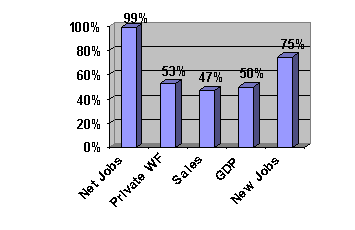 Figure 1, Small Business 1990s Economy Contribution Figure 1, Small Business 1990s Economy Contribution
Source: Small Business Administration,
Office of Advocacy, Facts About Small Business, Washington, DC, 1997, p. 1 and Small
Business Card, 1996, pp. 1, 2. |
Small Business Growth The marketplace for the purposes of this
discussion is defined as independently owned businesses with fewer than 500 employees.
Validating the positive outlook of the PEO industry, the Small Business Administration
statistics indicate small businesses have been a virtual dynamo in the U. S. 1990s
economy. As Figure 1 portrays, small businesses have dominated as a major player,
accounting for almost 99 percent of the net jobs from 1991-95. Further, these businesses
employed 53 percent of the private workforce, provided 47 percent of all sales, produced
50 percent of the private gross domestic product, and created 75 percent of the 1995 2.5
million new jobs. |
Women and Minority Owned Businesses
By segmenting the marketplace, some insight is gained into the contribution of women
and minority entrepreneurs to small-business growth. Women and minority owned small
businesses continue to be major contributors to the economy.
The latest data for these entrepreneurs does not include all minorities, only Women,
Blacks and Hispanics. As shown in Table 1, in 1992 close to 6 million women owned firms;
there were nearly 621,000 Black owned and 772,000 Hispanic. Women owned businesses
accounted for close to $643 billion in sales for 1992, while Hispanics accounted for about
$73 billion and Blacks $32 billion. Furthermore, Women owned businesses provided jobs for
15.5 million persons5.
Table 1
Women and Some Minority Small Business 1987-92 Growth
Category |
1987 |
1992 |
%
Change |
'92
Sales Billion $ |
Women |
4,112,787 |
5,888,883 |
43.1 |
$643 |
Black |
424,185 |
620,912 |
46.4 |
32 |
Hispanic |
422,373 |
771,703 |
82.7 |
73 |
Total |
4,961,332 |
7,283,490 |
46.8 |
$784 |
Source: Small Business Administration, Office of Advocacy, Facts About Small
Business, Washington, DC, 1997, p. 1-2.
Looking back to the 1982-87 period when data for all minorities were available, Table 2
shows Asian American / Pacific Islander were the major growth small businesses, up
slightly over 89 percent from 1982, followed closely by Hispanics. Hispanic business
growth for both periods is exceptional. Moreover, all of these business owner types are
rapidly becoming major players in the smaller business marketplace.
Table 2
1982-85 Women and Minority Small Business Growth
Category |
1982 |
1987 |
%
Change |
| Women |
2,613,000 |
4,113,000 |
57.5 |
| American Indian / Alaskan
Native |
14,000 |
21,000 |
50.0 |
| Asian American / Pacific
Islander |
188,000 |
355,000 |
89.3 |
| Black |
308,000 |
424,000 |
37.6 |
| Hispanic |
234,000 |
422,000 |
80.3 |
Source: Small Business Administration, Office of Advocacy, Small Business Answer
Card, 1996, Washington, DC, 1997, p. 2
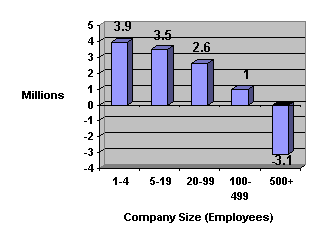
Figure 2, 1991-95 Employee Growth by Small Business Size
Source: Small Business Administration, Office of Advocacy,
Small Business Answer Card, 1996, Washington, DC, 1997, p. 2 |
Job Creation by Business Size
and Type What are the sizes of businesses creating jobs?
For the period 1991-95, businesses with less than 500 employees grew by nearly 11
million employees. As Figure 2 depicts, small businesses with 1-19 employees accounted for
slightly over 67 percent of the job growth; those with 20-99 made up 23.4 percent; and
100-499 a little over 9 percent; whereas companies with 500 plus employees lost over 3
million jobs. Remarkably, companies with employees size of 1-99 accounted for 91 percent
of the growth. |
Percentage change in job growth by size and industry are shown in Table 3. The 1-99 size
companies are the drivers, whereas the 100 + have been lagging. More specifically, in the
1990's the fastest job growth sector for small businesses has been restaurants, outpatient
care facilities, office of physicians, special trade construction contractors, computer
and data processing services, credit reporting and collection firms, medical and dental
laboratories, providers of day-care, and counseling and rehabilitation services6.
Table 3
Percentage Change in Job Growth By Industry Size
Industry |
# Employees |
1-99 |
100+ |
| Manufacturing |
9.9 |
-2.4 |
| Wholesale/Retail |
3.9 |
0.2 |
| Finance, Insurance, Real
Estate |
3.0 |
-2.2 |
| Services |
7.2 |
0.8 |
| All Other Sectors Incl.
Mining, Construction, Transportation |
4.4 |
-3.2 |
Source: Small Business Administration, Office of Advocacy, Small Business Answer
Card, 1996, Washington, DC, 1997, p. 2
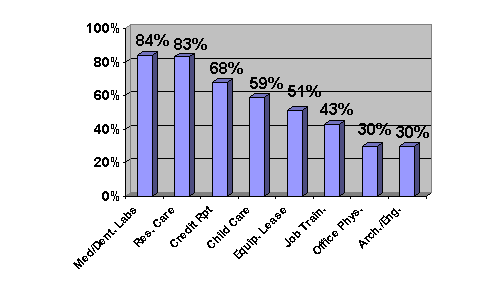
Figure 3, Fastest Growing Small Business Sectors to Year 2005
Source: Small Business Administration, Office of Advocacy,
Facts About Small Business, Washington, D.C., 1997, p. 2. |
Looking into the future, by 2005 small businesses are expected to
create 60 percent of all new jobs. As shown in Figure 3, the fastest-growing are projected
to be medical and dental laboratories with 84 percent, residential care 83, credit
reporting 68, child care 59, equipment leasing 51, and job training 43 percent.
Additionally, office physicians and architectural / engineers services are predicted to
grow 30 percent and the restaurant industry as a whole is to add 1.02 million jobs. |
Geographic Business Growth Distribution
Looking at the regions, since 1985 the South Atlantic region had the strongest and
continuing small business growth with the Pacific region second. There has been reasonable
growth in the East North Central Region with the Middle Atlantic and New England regions
having slight growth. The other regions have been declining, with the West South Central
region showing major business start-up decline.
Addressing 1996 growth, 170,475 companies started, employing 846,973 people. Figure 4
shows start-up by region and state. Relative to region, the South Atlantic had the largest
number of starting companies with 32,142, followed by the Mid-Atlantic 30,137, Pacific
30,070 and East North Central 23,280. From a State point of view, the largest number of
start-ups were located in California with 23,987 followed by New York 15,174, Texas
12,329, and Florida 12,299.
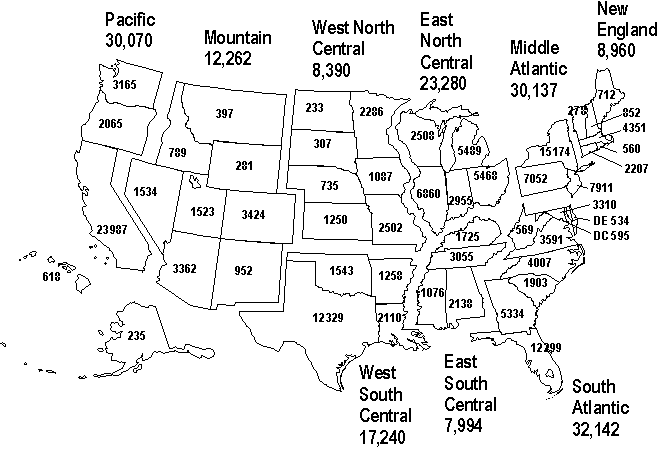
Figure 4, 1996 Region and State Company Start-ups
Source: The Dun & Bradstreet Corporation; Business Starts Record
1995-1996, Murray Hill, NJ, 1997, pp. 4-5.
In total, from a positive perspective, most of the above data demonstrates a robust
small-business economic climate, supporting the enthusiasm throughout the PEO industry.
Women and minority firms are growing contributors, with Hispanic and Asian start-ups the
fastest growing. The 1-99 employee size companies have accounted for the majority of the
growth and this percentage is expected to increase through the end of the century. Much of
the growth is expected in the health related fields. The major growth regions are
projected to continue to be the South Atlantic and Pacific, with California being the
leading small business start-up state.
Some Negative Marketplace Characteristics
As can be seen, small businesses have been, are, and will continue to be the backbone
of the economy. However, a large percentage of start-ups will end in dissolution, i.e.
businesses which will fail or discontinue operations. Only 30 percent will survive!
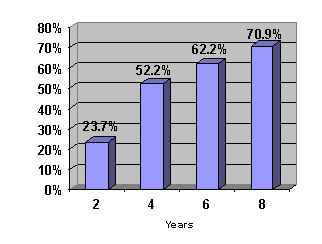 Figure 5,
Percentage Dissolution by Years in Business
Source: Small Business Administration, Office of Advocacy,
Small Business Answer Card, 1996, Washington, DC, 1997, p. 3 |
Dissolution Time Frame
Nearly 71 percent of all start-up businesses will be dissolved within 8 years.
Figure 5 points out the dissolution by yearly increment. In effect, a PEO with clients who
were start up businesses in the past 8 years can assume dissolution losses in the 20-30
percent range per year. In other words, if a PEO has an annual 18 percent client turnover
rate, 20-30 percent more than likely will be for reasons of dissolution. |
Dissolution by Small Business Size and Age
Looking at dissolution relative to small business size, Table 4 shows the attrition
rate by those creating less or more than 5 jobs. In all cases smaller firms have the
higher percentage dissolution; by year 8 almost 47 percent will disappear. Nevertheless,
the 5 plus employee firm dissolutions are not to be ignored for they track fairly close to
the 1-4 firms for the first 6 years. Moreover, a large number of 50 to 499 employees firms
will dissolve in this continuing 8 year start-up and dissolution cycle.
Table 4
Company Dissolution by Age and Employee Size
Company Age
In Years |
Job Creation |
1-4 |
5 or
More |
2 |
8.3% |
6.0% |
4 |
19.6% |
13.1% |
6 |
23.5% |
21.1% |
8 |
46.5% |
30.0% |
Source: Small Business Administration, Office of Advocacy, Small
Business Answer Card, 1996, Washington, DC, 1997, p.3.
Franchiser Dissolution
The franchiser dissolutions have a dual meaning for the PEO industry, particularly
those who franchise PEOs or establish relationships with franchisers to leverage for
growth. The fact is, franchisers on the average have a higher dissolution rate than any
other business type. Table 5 compares dissolutions; only the 6 year dissolution time frame
for all companies shows small differential in favor of the franchisers. Therefore this
type of business could be assumed to be a higher risk. Recent research speculates that up
front royalty, marketing and other fees may make the costs exceed the benefits; moreover,
as a group, owners tend not to be as highly educated as other small business startups.7
Table 5
Comparison of Business Dissolutions Timeframe Relative to Franchisers
Age in
Years |
All
Firms |
Franchisers |
Creators
of 1-4 Jobs |
Creators
of 5+ Jobs |
2 |
23.7% |
25.4% |
8.3% |
6.0% |
4 |
52.7% |
59.2% |
19.6% |
13.1% |
6 |
62.2% |
61.6% |
23.5% |
21.1% |
8 |
70.9% |
72.5% |
46.5% |
30.0% |
Source: Small Business Administration, Office of Advocacy, Small Business Answer
Card, 1996, Washington, DC, 1997, p.3.
Age and Type of Business Failure
What business will fail, When and Why? These are important questions to be answered
when marketing and/or sales personnel are qualifying prospects. So who are risk
industries? Dun & Bradstreet has collected and analyzed such data for 9 industry
categories. Dun defines failures as "businesses involved in court proceedings or
voluntary action involving losses to creditors". Businesses that discontinue
operation for reasons such as loss of capital, inadequate profit, ill health, retirement,
etc. are not recorded as failures.
As depicted in Table 6, the highest consistent failure rate of 20 percent or more in
the first 3 years are associated with services, retail, wholesale, transportation and
public utilities, manufacturing and mining businesses. Moreover services, retail,
wholesale, transportation and public utilities and manufacturing have average failure
rates exceeding 40 percent by the end of their 5th year. These 5th
year failure numbers are fairly consistent since 1990. For the 6 to 10 year time frame
failures for all industries, with the exception of finance, insurance, real estate and
construction, cluster in the 20 percent range, with mining, transportation, and services
averaging in the high 20s.
Table 6
Failure by Age of Business by Industry
Year |
Agriculture, Forestry & Fishing |
Mining |
Construction |
Manufacturing |
Transp. & Public Utilities |
Wholesale Trade |
Retail Trade |
Finance, Insurance & Real Est. |
Services |
| 3 or less |
|
|
|
|
|
|
|
|
|
| 1990 |
13.7 |
19.3 |
18.2 |
29.2 |
27.1 |
25.3 |
33.0 |
21.5 |
28.4 |
| 1991 |
12.8 |
27.8 |
16.9 |
25.7 |
24.6 |
25.8 |
30.7 |
18.3 |
25.5 |
| 1992 |
13.0 |
23.1 |
15.5 |
25.2 |
23.5 |
24.8 |
30.3 |
17.0 |
25.1 |
| 1993 |
13.8 |
24.0 |
15.7 |
25.5 |
23.9 |
25.0 |
30.5 |
18.8 |
25.7 |
| 1994 |
15.7 |
23.4 |
16.0 |
24.5 |
25.3 |
24.4 |
29.8 |
21.2 |
24.6 |
| 1995 |
19.8 |
23.2 |
16.6 |
23.6 |
26.2 |
23.4 |
30.0 |
20.4 |
26.5 |
| 1996 |
19.7 |
21.2 |
18.0 |
23.7 |
28.3 |
23.9 |
31.7 |
20.4 |
29.5 |
| 5 or less |
|
|
|
|
|
|
|
|
|
| 1990 |
26.0 |
36.5 |
35.0 |
46.7 |
44.6 |
42.4 |
50.5 |
36.9 |
45.5 |
| 1991 |
25.2 |
41.2 |
32.6 |
42.7 |
40.0 |
41.8 |
47.8 |
33.3 |
42.1 |
| 1992 |
23.2 |
35.7 |
30.5 |
41.9 |
40.2 |
41.0 |
47.1 |
33.2 |
40.9 |
| 1993 |
23.9 |
36.6 |
30.6 |
42.0 |
40.6 |
41.1 |
57.3 |
34.8 |
41.4 |
| 1994 |
27.2 |
35.8 |
29.5 |
40.3 |
42.6 |
41.2 |
46.7 |
33.4 |
41.4 |
| 1995 |
28.5 |
36.6 |
30.1 |
39.4 |
42.5 |
39.0 |
46.5 |
33.6 |
41.7 |
| 1996 |
28.8 |
34.3 |
31.7 |
39.3 |
44.8 |
41.0 |
47.5 |
32.6 |
44.7 |
| 6-10 yrs |
|
|
|
|
|
|
|
|
|
| 1990 |
22.9 |
30.5 |
38.6 |
23.1 |
26.4 |
27.2 |
23.0 |
30.0 |
26.3 |
| 1991 |
22.0 |
29.3 |
29.6 |
24.8 |
28.4 |
26.3 |
24.9 |
32.8 |
28.5 |
| 1992 |
23.1 |
28.4 |
30.6 |
25.1 |
28.2 |
26.8 |
25.7 |
31.1 |
28.4 |
| 1993 |
23.2 |
28.7 |
30.6 |
25.1 |
28.0 |
26.8 |
25.6 |
30.5 |
28.2 |
| 1994 |
22.1 |
26.9 |
29.9 |
26.7 |
27.7 |
26.0 |
25.2 |
30.4 |
27.2 |
| 1995 |
23.0 |
21.8 |
28.6 |
26.1 |
26.5 |
26.1 |
25.2 |
29.7 |
25.9 |
| 1996 |
24.4 |
24.8 |
28.2 |
25.3 |
23.6 |
24.3 |
25.2 |
27.0 |
24.9 |
Source: The Dun & Bradstreet Corporation, Business Fail Records, 1990-91 through
1995-96, New York, NY
Consistently High Failure Businesses
Within the 9 industry categories, there appears to be business types which consistently
have, by far, the highest number of failures of any others in the category. For example,
the Dun & Bradstreet data for 1991 through 1996 shows within Agriculture, Forestry and
Fishing, both Agricultural Crop Production and Agricultural Service businesses having 2 to
3 times the failure rate of the next business type, and 30 times or more of others in the
category. This is true for all the business types listed in Table 7. Only those classified
as a miscellaneous business in each category usually have higher failure rates.
Table 7
Consistent High Failure Business Types
- Manufacturing
- - Printing & Publishing
- - Industrial Machinery & Equipment
- - Fabricated Metal Products
- - Apparel & Other Textile Products
|
- Wholesale Trade
- Professional & Commercial Equipment
- Machinery, Equipment & Supplies
- Groceries & Related Products
- Apparel, Piece Goods & Notions
|
- Agriculture, Forestry & Fishing
- Agricultural Crops Production
- Agricultural Services
|
- Transportation & Public Utilities
- Trucking & Warehousing
- Transportation Services
|
- Mining
- Coal Mining
- Oil & Gas Extraction
|
- Transportation & Public Utilities
- Trucking & Warehousing
- Transportation Services
|
- Finance, Insurance & Real Estate
- Real Estate
- Insurance Agents Brokers & Services
- Holding & Other Investment Offices
|
- Services
- Management & Public Services
- Beauty Shops
- Laundry, Cleaning & Garment
- Hotel & Other Lodging Places
- Building Services
- Computer & Data Processing
- Mail, Reproduction & Steno
- Auto Repair, Service & Parking
- Health
- Miscellaneous Repair
- Social Services
- Amusement & Recreation
|
- Retail Trade
- Eating & Drinking Establishments
- Furniture & Home Furnishing Stores
- Apparel & Accessory Stores
- Automotive Dealers & Service Stations
- Food Stores
- Gift, Novelty & Souvenir Shops
- Sporting Goods & Bicycle Shops
- Non-Store Retailers
|
Source: The Dun & Bradstreet Corporation, Business Failure
Records, 1990 through 1996, New York, NY
As can be seen, when compared with previously presented data, the fastest growing
business types are also among those with the highest failure rates. These include special
trade contractors, eating and drinking establishments, machinery and equipment suppliers,
computer and data processing services, along with health and social services.
Business Failure Causes
What are the reasons businesses have failed? Table 8 shows 7 cause classifications:
Neglect, Disaster, Fraud, Economic Factors, Experience, Finance and Strategy. Percentage
by industry is presented for 1993, the last year data is available. By far the greatest
number of failures were associated with interrelated Economic and Financial causes,
accounting on the average for 82 percent. Moreover, both accounted for 93 percent of
service industry failures. Within Economic causes the preponderance of failures were
attributed to inadequate sales and industry weakness. Financial causes were primarily
associated with burdensome institutional debt, heavy operating expenses or insufficient
capital. These Economic and Financial reasons and percentages are fairly consistent
beginning in 1989. However prior to 1988 -1989, the experience factors also make a large
contribution to failure, including such reasons as a lack of business knowledge, lack of
managerial line experience or incompetence, which bore the greatest burden for business
demise. Dun has consolidated some Causes categories and attributes since 1988-89. See
prior reports for more detail.
Table 8
Percentage Failures By Cause
Causes |
Agri.,
Forest. & Fish. |
Mining |
Construct. |
Manufact. |
Transp.
& Public Utilities |
Wholesale
Trade |
Retail
Trade |
Finance,
Insur. & Real Est. |
Services |
| Neglect: Business
conflict, family problems, lack of commitment, poor work habits. |
4.4 |
11.1 |
6.2 |
4.0 |
4.5 |
4.7 |
3.7 |
9.5 |
1.7 |
| Disaster: Acts of
god, burglary, fire, death of owner, strike. |
2.2 |
0.0 |
4.9 |
8.1 |
1.8 |
8.3 |
13.1 |
4.8 |
2.3 |
| Fraud: employee
Fraud, embezzlement, false statements, irregular disposal of assets, misleading name,
premeditated overbuy. |
0.0 |
3.7 |
1.4 |
3.7 |
6.4 |
9.0 |
3.1 |
11.9 |
2.4 |
| Economic: Interest
rates, inadequate sales, industry weak, inventory difficulty, poor growth prospects, poor
location. |
47.8 |
77.8 |
36.6 |
45.2 |
46.3 |
48.3 |
38.4 |
14.3 |
32.0 |
| Finance:
Institutional debt, heavy operating expense, insufficient capital |
43.4 |
7.4 |
47.4 |
36.3 |
40.1 |
26.8 |
39.8 |
58.9 |
61.0 |
| Experience: Lack of
business knowledge, line or managerial experience |
0.0 |
0.0 |
0.5 |
1.0 |
0.0 |
1.5 |
1.1 |
0.6 |
0.2 |
| Strategy: Excessive
fixed assets, over expansion, receivables difficulties |
2.2 |
0.0 |
3.0 |
1.7 |
0.9 |
1.4 |
0.8 |
0.0 |
0.4 |
Source: The Dun & Bradstreet Corporation Business Failure Record 1992 Final,
1993 Preliminary, New York, NY, 1994.
Geographic Business Failures Distribution
Where are the failures occurring? Historically speaking8, during the 1988-91
period, all regions were having major failures with New England, Middle Atlantic, Pacific
and South Atlantic leading the way. Since then failures have been steadily on the decline
in the New England and South Atlantic regions. In the past two years, increased failures
have been recorded in the West South Central averaging 5.5 percent, and Mountain with 11.2
percent. Moreover, for the 1995-1996 period, East North Central and East South Central and
Pacific regions have shown a 9.5, 10.7 and 5.5 percent failure increases respectively.
From a current perspective, 1996 data in Figure 6 distributes failures by region and
states; 71,811 companies failed, up slightly over 1995. The Pacific region has by far the
largest number, followed by the Mid Atlantic with less than half that of the Pacific; West
South Central, South Atlantic and East North Central each are in the 8,000 failure ranges.
By state, California and Texas have the largest number of failures; New York,
Pennsylvania, Florida, Oregon, Illinois, New Jersey, Ohio and Colorado are in the 2,000s.
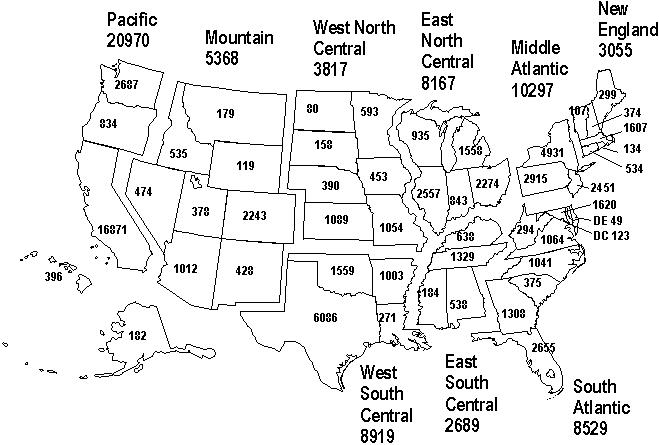
Figure 6, 1996 Region and State Business Failures
Source: The Dun & Bradstreet Corporation, 1995 Final, 1996
Preliminary Business Failure Record, Murray Hill, NJ, 1997, p. 4
Comparing business failure regions in Figure 6 with startups portrayed in Figure 4, it
can be seen, for example, the Pacific region had 30,070 startups and 20,970 failures;
contrasted with South Atlantic with 32,142 startup and only 8,529 failures; or a
failure/startup ratio of 1.43 versus 3.76 respectively. In other words, the South Atlantic
region has close to 4 times the business startups as it does failures, or a large net gain
in businesses for 1996. With the exception of the West South Central, which was second to
the Pacific in failures, all others can be seen to have fairly good business gains during
1996.
Specific Indicators
After looking at the discontinuance and failure data, What seems to tip the scale to
success, besides good luck and persistence? Success and failure are not necessarily
straight lines to the top or bottom. So what are some possible indicators underlying the
data?
General Small Business Indicators 9, 10, 11, 12
Government funded research points to several possible success/failure indicators for
small businesses. However, these findings should not be considered the final word on the
topic, but considered as guidelines. Generally speaking, the following are indicators of
businesses more likely to succeed. These are not necessarily in order of importance.
- - Greater number of employees
- - Sales dollar volume
- - Years in business
- - Open market competition
- - Availability of large amounts of capital
- - Founder run company
- - Long tenure management
- - Better educated management
- - Efficiently run operation
- - High quality business
- - Second generation management brought up in company
- - Purchased older business, and
- - Long term management remains when purchased
Interestingly, it was found when employee size reached the 5-9 range discontinuance
dropped from 66.1 percent to 14.9 percent; at 10-19 it fell to 5.5 percent; at 20-49 it
fell to 2.4 percent, and at 50 plus, 0.9 percent. Similarly, as total sales revenues rise,
discontinuances drop. At $100,000-$199,999 discontinuance was 6.1 percent, down from an
average of 17.5 percent for all those companies under $100,000; at $500,000-$999,999 it
was 1.2 percent, and over $1 million 0.7 percent.
It is also obvious from the listing a key factor in survival is management experience,
tenure and education. These all tend to relate to high quality and efficient operations.
However, management founders with 23 plus years in business tend to have increased
discontinuance. Another dimension of management is that founder run small businesses have
a greater survival rate than non-founder. Furthermore, older small businesses which were
purchased tended to be sounder, more survivable than younger purchased businesses. In
fact, an early sale of a young business is indicative of a possibly poorer quality
business.
While education is an important ingredient in the management picture, experience is
more important. One could say for example, fifteen years diversified management experience
would outweigh an MBA from Harvard with little or no experience. Another point, the
research indicated those businesses catering exclusively to a minority rather than a
diverse market are more likely to dissolve. Finally, for white male owners, all other
factors controlled, the firm age is the strongest single determinant of small business
survival.
Rapid Growth Small Business Indicators
The pursuit of larger, fast growth companies by the PEO industry can be particularly
high risk, given the larger number of dollars involved and day to day unknowns associated
with rapid growth. Each year, Forbes Magazine13 selects its top 200 hot growth,
public small businesses evaluating such factors as return on equity, 5 year growth, value
of $10 thousand invested, and management. Over the years, only 42 percent have graduated
to bigger and better things, 58 percent have encountered difficulty, some ending in
bankruptcy, reorganization or liquidation. Generally, Forbes has found the downfall of
these fast growth small companies to be:
- - Geographic expansion without the support infrastructure
- - Success based on single large customer
- - Product or services based on a fad
- - Market saturation by competition
- - Technology lead erosion
- - Accounts receivable growing at faster rate than sales
- - High debt during and after expansion, and
- - Lack of quality management experience and depth
Support infrastructures relates to personnel, financing and products/services
inventories, which cuts a large swath across a company's capabilities. "Numbers
aren't everything" is pointed out. Some of the key insight factors never pass through
the profit and loss statement --- such as customers thoughts about the company,
management's main motivation, employee morale, and great new products in the pipeline or
reaching the market. Moreover, a key point that was made about management is their need to
have the capability to cope with internal and external multifaceted complexities of a
rapid growth environment; many do not!
So the key question is ... What does all of this mean to me?
Implications
All things being equal, there is a high probability if a PEO were to randomly select
its clients, dissolutions and failures would approximate the rates discussed. Those PEOs
concentrating in high failure geographic areas or on the consistent high failure business
types would more than likely have even higher risk and client failure rates. You may say,
"We have client selection criteria for minimizing risk". However, are these
criteria rigorous enough? When were they last updated?
Further, is there client risk maintenance criteria? In other words ... Is there
ongoing criteria to identify potential failure risk? Why? While general client turnover
can have a financial impact, unforeseen failures can cripple or create the foundation for
a PEOs demise. In addition, for public PEOs or those thinking IPO, shareholders are
expecting growing profits and pursuing high risk clients without safety nets could lead to
unhappy investors and poor stock performance. Knowing the symptoms before and after
relationships are established, and putting protective systems into place is the key to
survival in this high risk market. Given the percentage of failures, qualifying clients
should be an ongoing endeavor. The above discussion of specific indicators provides some
insight into what to look for initially and as you continually qualify clients.
Establishing Risk Profiles
It is obvious from this brief analysis that high risk industries and specific business
types can be identified from data available from the Federal Government and Dun &
Bradstreet. Using these, Workers' Comp and other data, a PEO can classify its clients and
determine where they stand relative to overall risk. Furthermore, former clients also can
be analyzed to determine risk trends. In other words, a PEO can create more precise Risk
Profiles and establish not only acceptable risk levels, but also determine whether risk is
remaining the same, increasing or decreasing.
Evolving Acceptance Criteria
By establishing and using Risk Profiles, PEOs may be able to control risk intake.
Acceptance criteria that has worked in the past may not be as useful today! As the
industry has matured and learned more about itself and working relationships with clients,
new criteria may be needed and/or current criteria updated. This is particularly important
considering the expansion of once local PEO into state, regional and national markets. By
looking closely at the various reasons for failures in new markets and isolating tell-tail
signs symptomatic of failure, better client selection criteria can be created. However, it
must be remembered, you are dealing with variables and not constants; changes in emphasis,
or reasons for failures will occur. Therefore, marketplace monitoring is necessary, and
adjustments need to be made accordingly.
Ongoing Qualifying
Relationships between the PEO and client have changed from a simple
payroll/benefits/fee relationship to a partnership, where both parties have a stake in the
health and stability of each other. Each is looking for mutual long term benefits from
their investment. Therefore, ongoing qualifying can serve 3 basic purposes: 1) determining
the viability of the client, 2) feedback from the client for PEO improvements, and 3) PEO
interventions for assisting clients.
In order to create an on-going, qualifying capability requires establishing a client
feedback/feed forward system; communication mechanisms which permit monitoring client
vital signs, and PEO service quality. Some of the information collected during the initial
qualifying stage must be continued along with that which may be unique to and indicative
of problems in the industry or business type. Also information must be collected from
clients about the quality of PEO service, so improvements in product/services, sales and
service personnel and management can occur.
Establishing such a system is not free; it is a question of cost-benefits. Some sort of
feedback for improving services should be implemented with all clients. However, for
selected high risk clients continual in-depth qualifying, perhaps auditing, should exist;
the cost of not doing it can be greater than the cost of doing it! The opportunity for
open communication can help identify and resolve many potential problems before they
mushroom, and also help establish a long-term trusting relationship.
Intervention Opportunities
In addition, continual client qualifying can provide an opportunity for PEO timely
intervention with assistance. Certain types of intervention could well be new
product/services which generate additional revenues for the PEO, while others may be
provided by other companies such as banks or management consultants. Moreover it is
possible PEOs might see opportunities to purchase such entities and "spin off"
different businesses.
In conclusion, as you reflect on the above information, ask yourself the question ...
"Where does my PEO stand relative to risk ... success or failure? Is your PEO rolling
the dice?
Endnotes:
1
Carlos Saladrigas, "Prospective on the PEO Industry" in SI Review,
Vol. 2, No. 4, July/August 1997, pp. 28-62.
2
"HR Paperwork Handed to PEOs" in The Business Journal,
Minneapolis, St. Paul City, October 6, 1997, pp. 1-3.
3
Ibid., Saladrigas.
4
"NAPEO's 1997 Financial Ratio Survey Results", NAPEO, Alexandria, VA,
October 9, 1997, p. 1.
5
SBA, Office of Advocacy, Facts About Small Business, Washington, DC,
1996, pp. 1-5.
6
Ibid., p. 2
7
Timothy Bates, Firms Started as Franchises Have Lower Survival Rates than
Independent Small Businesses, Research Report CES 94-3, Center for Economic Studies,
US Bureau of Census, Washington, DC, May 1994, p.14.
8
The Dun & Bradstreet Company, Business Failure
Records, years 1987 through 1996, New York, NY.
9
Timothy Bates, Entrepreneurial Factor Imputs and Small
Business Longevity, Research Report CES 89-4, National Science Foundation Grant,
Washington, DC, June 1989.
10
Timothy Bates and Alfred Nucci, An Analysis of Small
Size and Rate of Discontinuance, Research Report CES 90-2, Center for Economic
Studies, U.S. Bureau of Census, Washington, DC January 1990.
11
Thomas J. Holmes and James A. Schmitz, Jr., On the
Turnover of Business Firms and Business Managers, Research Report CES 92-6, National
Science Foundation, Washington, DC, July 1992.
12
Thomas J. Holmes and James A. Schmitz, Jr., Managerial Tenure, Business Age
and Small Business Dynamics, Research Report CES 92-11, Center for Economic Studies,
U.S. Bureau of Census, Washington, DC, September 1992.
13
William P. Barrett, "The Perils of Success", Forbes, Vol.
160, No. 10, November 3, 1997, pp. 129-137.
- For more information, call or write:
- Deva Industries, Inc.; 1818 SE 37th Street; Cape Coral, FL 33904; Phone:
(239) 540-0388
